
How it works
Grease filtration explained
Understanding how wool grease filters work — and how they fit into your kitchen's wider extraction maintenance programme.
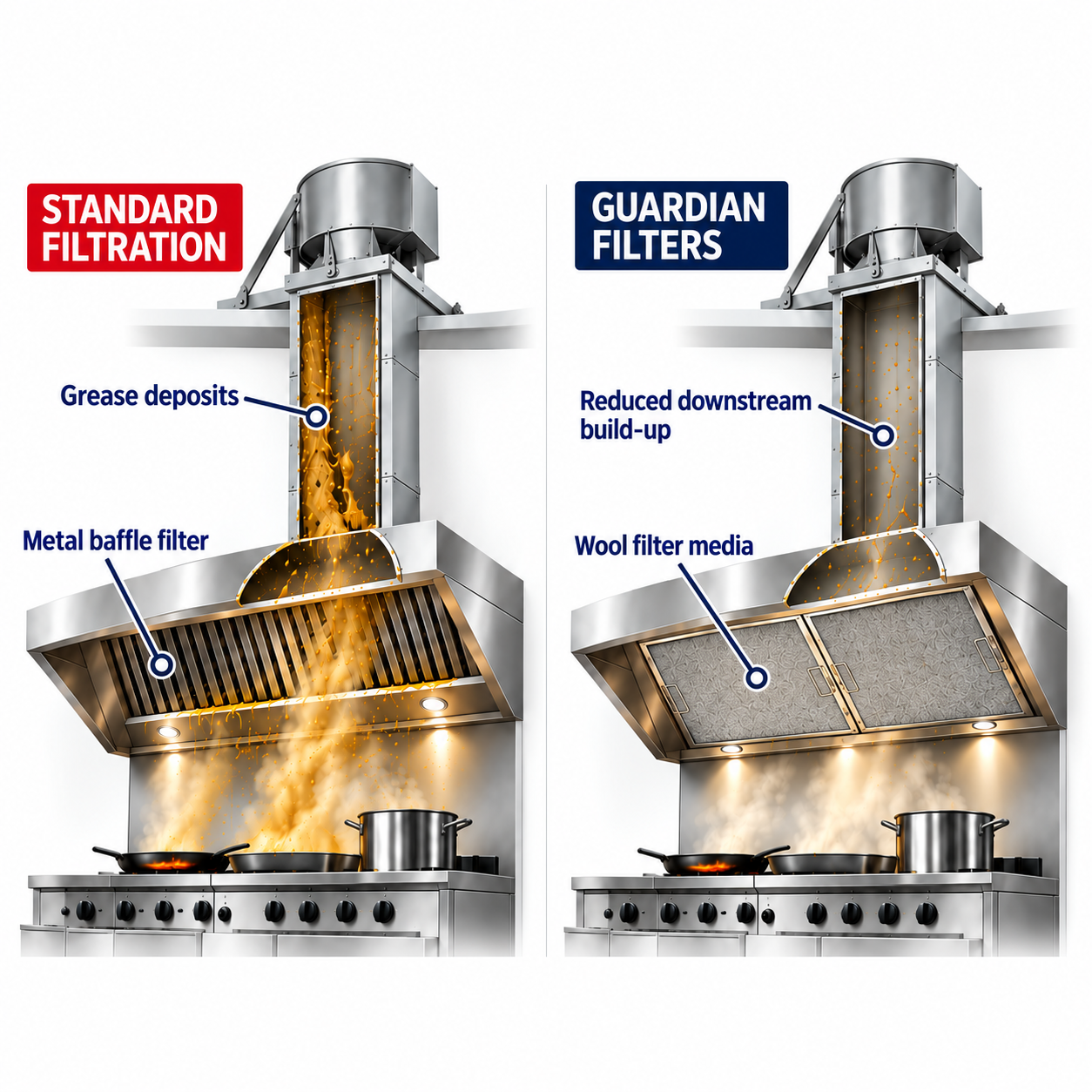
Better grease filtration starts at the canopy
Cooking releases airborne grease into your kitchen’s extraction system. Grease that passes through the canopy filters can settle inside the ductwork, increasing fire risk and adding to cleaning and maintenance demands. Standard metal baffle filters capture some of this grease, but a proportion continues downstream. Guardian Filters add wool filter media at the canopy to capture more grease before it reaches the ductwork, helping to reduce the build-up illustrated above.
By tackling grease at its source, effective filtration helps keep your extraction system cleaner and easier to maintain. Regular filter changes, inspections and duct cleaning remain essential.
The filtration process
How wool filters capture grease
Air enters the canopy
Cooking fumes, steam, and airborne grease particles are drawn up into the extraction canopy by the ventilation fan.
Grease is captured
As air passes through the wool filter medium, grease particles are trapped within the fibres. Wool is a naturally effective filtration material, with a high surface area that captures grease efficiently.
Clean air continues
Filtered air passes through to the ductwork and out of the building, significantly cleaner than it entered.
Filter is replaced
Over time, the filter becomes saturated with grease and must be replaced. The frequency depends on your kitchen's cooking volume and style.
The bigger picture
Part of a wider extraction maintenance programme
Grease filters are one component of a complete extraction maintenance programme. For your kitchen to remain safe and compliant, the entire system — canopy, filters, ductwork, and fan — needs regular attention.
A typical maintenance programme includes regular filter inspection and replacement, periodic deep cleaning of the canopy and ductwork, and annual system inspection. Guardian Filters can advise on the right schedule for your kitchen based on your cooking volume and menu.
Regular filter replacement
Filters should be inspected frequently and replaced before they become saturated. Overloaded filters restrict airflow and increase fire risk.
Canopy cleaning
Grease accumulates on canopy surfaces as well as in filters. Regular cleaning prevents build-up and keeps the system working efficiently.
Ductwork inspection and cleaning
Ductwork should be inspected and cleaned periodically. The frequency depends on cooking volume — high-volume kitchens require more frequent attention.
System inspection
An annual inspection of the full extraction system helps identify any issues before they become serious problems.
Need help planning your maintenance schedule?
Our team can advise on the right filter replacement frequency and maintenance programme for your kitchen.